Showing posts with label Book Thief. Show all posts

Wednesday, October 29, 2008

The Book Thief review by Heidi

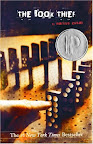
The Book Thief The Book Thief by Markus Zusak


rating: 5 of 5 stars
It makes sense to me that Death would not want to get involved in the lives of humans. He must do his job, be dispassionate. He explains quite carefully how he finds distractions in the colors, distraction from the ones he leaves behind, the survivors. So why does he choose to tell a story of a girl in Nazi Germany, a book thief?

Death first sees her when her little brother dies. Her mother is leaving her in the care of others, foster parents. Since this is Nazi Germany, I immediately wondered what would become of her. The girl finds her way with these new parents, with her new school, and you learn she can't read. Her foster father begins to teach her, with her first stolen book, "The Grave Digger's Handbook." Perhaps the title is what caught the attention of Death. Is it her innocent spirit that gets his attention? Is it her knack to find color in the world?

Even while a war rages and Nazi political-correctedness hovers over the lives of Liesel and her friends and family like stink over garbage, kids still go to school, compete in games, and find amusements to relieve their boredom. They also have secrets.

The language of the book is beautiful and compelling, and the reader, Allan Corduner, does do it justice. Listening had its pluses and minuses...it made the storytelling compelling...but it's not so easy to backtrack if you think you missed an important bit. Indeed there's at least one drawing in the book that I didn't see while listening. I look forward to reading the book as well, which I will do for my book group in April '09. I listened to it quite a while ago but am quite behind with my book remembrances.

View on my blog here.

Thursday, June 26, 2008

The Book Thief by Markus Zusak

I loved The Book Thief even more than I expected to after seeing glowing reviews everywhere. I rarely say anything like this, because it's hard to know what will last, but this is a book that I expect to become a classic.

My favorite thing about the novel is that Death is the narrator. He's not a bad guy, Death. And his narration, for me, is what really makes this book unforgettable.

The story is set in Nazi Germany, and the main character is a girl who loves to read, named Liesl. She's placed in a foster home with new parents she grows to love. She's friends with a neighbor boy named Rudy. And, being poor and at first barely literate, her only access to books is through theft. The first book she steals, or really finds on the ground, is The Grave Digger's Handbook, which she finds at her brother's funeral and secrets away. With the help of her foster father, she learns to read. The book is also definitely also a war story, though. As with many war stories, I was really struck by the strength of the human spirit and by the ability of some people to be so deeply good during horrifically bad times.

Zusak's writing is unique and gorgeously poetic, and the structure of the novel is intriguing. I also enjoyed the use of subtle foreshadowing to keep the reader alert and engaged. This book is a Printz honor book (along with many other awards) and is commonly considered a YA novel, but it's more than complex enough to satisfy an adult reader.

You can read an excerpt here, although the format lost something being transferred to a webpage.

You can read an interview with the author here.

Other reviews of this book:
Clare
Stefanie
Nyssaneala
Natasha

Cross-posted in my blog.

Tuesday, January 15, 2008

The Book Thief by Markus Zusak

Originally appeared at Becky's Book Reviews


Zusak, Markus. 2006. The Book Thief.

The Book Thief may just be the hardest book I've ever tried to review. It is beautiful. Though it can be ugly. It is intense. It is powerful. It is memorable. The first thing you should know about The Book Thief? It is narrated by Death. This is fitting in many ways since the setting is Nazi Germany during the Second World War. Death is the narrator, and he never lets you forget it. But there are many players--many characters--in the story that Death is relating to his audience all these years later. One of them is a girl, Liesel, and is known by Death as 'the book thief.' These thefts provide some structure to the text. (The structure is one of the odd things about the Book Thief. It isn't chronological. Death doesn't tell a story traditionally. He has his own way of jazzing it up, arranging it so it suits his needs and purposes.) The language, the style, is unique. I think it is written in such a way that you either really love it or you really don't. (It's written in such a way that you could almost open it to any page, and find a sentence or two or a whole paragraph that you want to just lift out and let resonate with you for a time.)

This is how it begins:

First the colors. Then the humans. That's usually how I see things. Or at least, how I try. Here is a small fact: you are going to die. I am in all truthfulness attempting to be cheerful about this whole topic, though most people find themselves hindered in believing me, no matter my protestations. Please, trust me. I most definitely can be cheerful. I can be amiable. Agreeable. Affable. And that's only the A's. Just don't ask me to be nice. Nice has nothing to do with me. (3)

It continues:

People observe the colors of a day only at its beginnings and ends, but to me, it's quite clear that a day merges through a multitude of shades and intonations, with each passing moment. A single hour can consist of thousands of different colors. Waxy yellows, cloud-spat blues. Murky darknesses. In my line of work, I make it a point to notice them. As I've been alluding to, my one saving grace is distraction. It keeps me sane. It helps me cope, considering the length of time I've been performing this job. The trouble is, who could ever replace me? Who could step in while I take a break in your stock-standard resort-style vacation destination, whether it be tropical or of the ski trip variety? The answer, of course, is nobody, which has prompted me to make a conscious, deliberate decision--to make distraction my vacation. Needless to say, I vacation in increments. In colors. Still it's possible that you might be asking, why does he even need a vacation? What does he need a distraction from? Which brings me to my next point. It's the leftover humans. The survivors. They're the ones I can't stand to look at, although on many occasions I still fail. I deliberately seek out the colors to keep my mind off them, but now and then, I witness the ones who are left behind, crumbling among the jigsaw puzzle of realization, despair, and surprise. They have punctured hearts. They have beaten lungs. Which in turn brings me to the subject I am telling you about tonight, or today, or whatever the hour and color. It's the story of one of those perpetual survivors--an expert at being left behind. It's just a small story really, about, among other things: a girl, some words, an accordionist, some fanatical Germans, a Jewish fish fighter, and quite a lot of thievery. (4-5)

Before the story gets underway, he invites the reader along for the journey:

Yes, often, I am reminded of her, and in one of my vast array of pockets, I have kept her story to retell. It is one of the small legion I carry, each one extraordinary in its own right. Each one an attempt, an immense leap of an attempt--to prove to me that you, and your human existence, are worth it. Here it is. One of a handful. The Book Thief. If you feel like it, come with me. I will tell you a story. I'll show you something. (14-15)

There is depth, substance, to these words, to this story. The descriptions. The details. The powerful sway of the words whether they're describing the beauty of love and family and friendship or capturing the ugly heaviness of hate, anger, and death. It's not an easy story to read. It's full of emotions. It's full of words. It's a book that at it's very heart and soul captures humanity in all its depths--the good, the bad, the ugly. Here is a book that captures what it means to be human.
One of the most memorable passages for me (224-236), and I hope this isn't much of a spoiler--is the hand drawn--hand written--portion written by "Max" for Liesel. I find it so powerful in its simplicity. So hauntingly beautiful. There is a second story specially written for Liesel by Max, this second one is found on pps 445-450. This is how that one begins, "There was once a strange, small man. He decided three important details about his life: 1) He would part his hair from the opposite side to everyone else. 2) He would make himself a small, strange mustache. 3) He would one day rule the world." (445)